From agricultural residues to soil-biodegradable products: SOUL project takes stock of its first year

The EU-funded initiative is developing 11 innovative bio-based products for agriculture and other outdoor applications, using at least 95% renewable raw materials. At their first annual meeting in Madrid, the 17 European partners reviewed progress on new biomaterials, biodegradation testing and plans for field demonstrations in five countries
by Emanuele Isonio
What happens to biodegradable plastic residues that may remain after the industrial composting of compostable packaging? This has been one of the most debated questions in recent years, especially after some studies detected microscopic fragments in compost produced from the treatment of organic waste.
Now a new study, conducted by researchers from the Universities of Montpellier and Paris-Saclay in collaboration with Michigan State University, provides an important answer: biodegradable microplastics that may remain in compost are not destined to persist in soil but continue their biodegradation process even after the compost is applied to agricultural land.
This finding strengthens the scientific evidence on the role of compostable packaging within the circular bioeconomy and, above all, on its relationship with soil health.
Madrid, 12 October 2026 – Can agricultural residues and other renewable resources be transformed into innovative products that perform effectively during use and biodegrade in soil afterwards? This is the challenge at the heart of SOUL, a European Innovation Action that has just completed its first year of activities.
Bringing together 17 partners from across Europe, the project aims to develop 11 bio-based products designed for applications in agriculture and other outdoor environments, where conventional plastics can be difficult to collect and may persist in the environment.
The solutions under development include mulch films, controlled-release fertiliser coatings, agricultural clips and twines, pheromone dispensers, turf nets, tree shelters and sports-field infill. All are designed to contain at least 95% renewable raw materials, sourced from agricultural residues, agro-industrial by-products and low-impact crops grown on marginal lands.
The goal is to combine technical performance, compatibility with existing manufacturing technologies and more sustainable end-of-life options, including biodegradation in soil where appropriate, as well as composting, reuse or recycling.
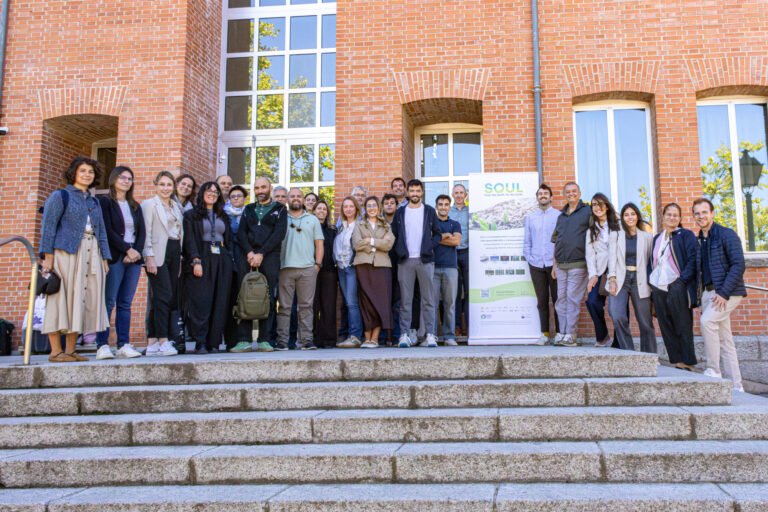
These objectives and the progress made towards achieving them were at the centre of SOUL’s first annual consortium meeting, held in Madrid on 7–8 October 2026, hosted by the Spanish National Research Council (CSIC).
From renewable feedstocks to innovative biomaterials
One of the main achievements of the project’s first year has been the progress made in developing new biomaterials with a high renewable content.
Research partners Novamont, CSIC, EVOenzyme and AITIIP have been working closely together, exchanging materials, technical knowledge and research findings to develop formulations that meet the requirements of the different applications.
Their work is being carried out in collaboration with industrial partners, including Tenax, Sicor and Moses, which are responsible for transforming the innovative materials into finished products.
During the Madrid meeting, Moses presented updates on manufacturing processes, including the definition of technical requirements and performance benchmarks.
A key challenge is to ensure that the new materials can be processed using existing plastic manufacturing technologies, while delivering the mechanical and functional properties required for their intended applications.
Testing biodegradation, safety and environmental performance
Developing bio-based alternatives is only part of the challenge. SOUL also aims to assess what happens to these materials at the end of their useful life, paying particular attention to biodegradation, potential environmental impacts and soil health.
Normec OWS and AIMPLAS are leading activities related to end-of-life scenarios and circularity. AIMPLAS is developing a modelling and prediction tool for biodegradation, while Normec OWS has begun working with biomaterial samples provided by project partners to investigate biodegradation behaviour, ecotoxicity and effects on soil fertility.
These activities are essential to assess whether the proposed solutions can meet the project’s environmental objectives and avoid unintended impacts on soil ecosystems.
The development process also follows a Safe and Sustainable by Design (SSbD) approach, which integrates safety and sustainability considerations from the earliest stages of product development.
Holoss is supporting this work through dedicated guidelines, an SSbD principles document and the design of a Life Cycle Assessment (LCA) process tailored to SOUL’s materials and applications. During the meeting, Holoss also presented the results of the project’s first Gender, Ethics and Inclusion survey and reported on the submission of its Gender Equality Plan.
Five European countries to host field demonstrations
The next major step will be the validation of the new solutions under real-world conditions.
Five demonstration sites in Italy, Spain, Portugal, Poland and Ireland will provide the opportunity to assess product performance in different environmental and operational contexts.
IUNG – Institute of Soil Science and Plant Cultivation, which leads the demonstration and validation activities, presented the progress made in preparing the validation framework. The detailed testing plan will be finalised over the coming months with contributions from the consortium partners.
These demonstrations will be crucial to understanding how the innovative products perform in practical applications and to generating evidence to support their potential future market uptake.
Connecting research, industry and European policies
Alongside technological development, SOUL is working to ensure that its results respond to the needs of industry, farmers, policymakers and other stakeholders across the bioeconomy value chain.
An important milestone during the first year was the establishment of the SOUL Multi-Actor Advisory Panel (MAP), coordinated as part of the project’s stakeholder engagement activities. The panel held its first meeting in September 2026, bringing together external stakeholders to exchange knowledge, provide feedback and contribute to the development of solutions aligned with real-world needs.
Re Soil Foundation, which leads the project’s communication, dissemination, training and stakeholder engagement activities, presented the progress achieved during the first year and outlined priorities for the months ahead.
Policy developments are another important dimension of the project. The European Bioeconomy Bureau has provided the consortium with around 20 policy updates over the past year and co-organised SOUL’s first policy workshop in Brussels in May 2026. A further thematic MAP meeting, focusing on EU policies and the bioeconomy, is scheduled for December.
Meanwhile, AITIIP, the project coordinator, presented the roadmap for identifying key stakeholders, potential market opportunities and the project’s Key Exploitable Results, with the aim of supporting future replication and commercial uptake.
“The first year of SOUL has progressed efficiently as expected. Every deliverable and milestone planned for this period was delivered on time, partners are already sharing the first soil-biodegradable materials with manufacturers, and one formulation has been produced at industrial scale. Meeting in person in Madrid, hosted by CSIC, helped us to revise all work done until now, to update all the consortium about the achievements and to plan ahead. Over the coming months
we will deliver the first biomaterials for its validation at industrial scale and prepare the field trials at demonstration sites in five European countries for SOUL biomaterials testing.” Carolina Peñalva, SOUL Project Coordinator, AITIIP.
The next steps towards more sustainable products
After its first year, SOUL is entering a new phase in which material development, environmental assessment and preparation for field validation will increasingly converge.
The priorities identified in Madrid include scaling up the development of high-renewable-content biomaterials, finalising the validation plans for the five demonstration sites, identifying the project’s most promising exploitable results and strengthening dialogue with stakeholders.
By combining research expertise, industrial innovation and environmental assessment, SOUL aims to demonstrate how renewable resources can help address end-of-life management, reduce carbon footprints, decrease and optimising input, and preventing soil contamination.
The ultimate ambition is to develop products that fulfil their function during use while offering environmentally sound end-of-life solutions, contributing to healthier soils and a more circular European bioeconomy.
About SOUL
SOUL is a European Innovation Action supported by the Circular Bio-based Europe Joint Undertaking (CBE JU) and co-funded by the European Union.
Coordinated by Fundación AITIIP, the consortium includes 17 European partners: Fundación AITIIP, EVOenzyme, CSIC – Spanish National Research Council, Asetaga, AIMPLAS – Plastics Technology Centre, Moses, Novamont, Tenax S.p.A., Alma Mater Studiorum – Università di Bologna, Re Soil Foundation, Amorim Cork Solutions, Sicor, Holoss, Samco Agricultural Manufacturing, Normec OWS, European Bioeconomy Bureau and IUNG – Institute of Soil Science and Plant Cultivation. Bedoukian, based in Switzerland, participates as an associated partner.
Photo caption: SOUL consortium partners gathered at the CSIC Instituto de Catálisis y Petroleoquímica in Madrid during the project’s first annual meeting, 7–8 October 2026.